
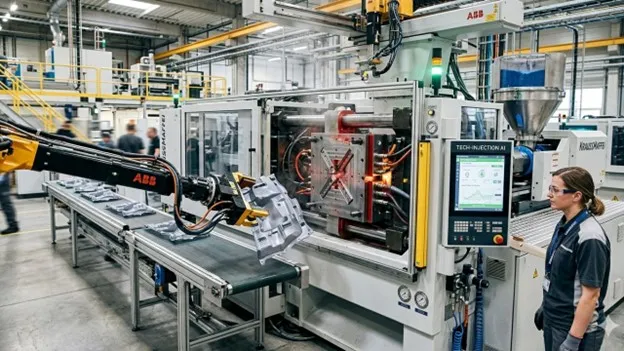
Even well-run molding operations run into friction. This guide looks at the problems that quietly disrupt quality and output, and how we handle them before they turn into expensive delays.
What You Will Learn in This Guide:
You will get a clear sense of where molding processes tend to break down, what causes those issues in practical terms, and how we correct them in ways that hold up over time.
Why Problems Show Up Even in a Controlled Process
Molding looks stable from the outside. Set the parameters, run the machine, collect parts. In reality, it rarely stays that clean for long. A degree or two in melt temperature, a slight shift in humidity, a material lot that behaves just a bit differently, and the whole process starts to drift. An injection plastic moulding machine will do exactly what it is told, which is the point and also the risk. If the inputs are off, even slightly, the output follows. We do not treat this as a surprise. We expect drift and stay ahead of it.
When Parts Stop Looking Right
You can usually spot trouble before the numbers show it. Edges soften, surfaces lose their finish, and dimensions start to wander. Warping and sink marks are common, but they are not random. They point to an imbalance somewhere in the cycle. Cooling might be uneven, pressure might be dropping too soon, or the fill rate might be just a little aggressive for the geometry. We do not jump to big changes. Small, controlled adjustments tend to fix more than sweeping ones. The work is in knowing which lever to touch and which to leave alone.
Materials Have Their Own Agenda
Plastic is not passive. It reacts to heat, moisture, and shear in ways that are easy to underestimate until something goes wrong. One batch runs clean, the next starts stringing or flashing, and nothing else seems different. Inside a plastic injection moulding machine, those differences become obvious fast. We pay close attention to drying time and storage conditions, and we watch how the material actually behaves during the run, not just what the spec sheet says. Sometimes the right move is not to fight the material at all, but to change it.
Machines Wear, Quietly
No one likes to blame the machine, but it earns a look more often than people admit. Hydraulics lose a bit of consistency, heaters drift, sensors age. None of it fails dramatically at first. It just nudges the process off center. We keep a close eye on patterns rather than waiting for a fault code. If a cycle starts taking longer for no clear reason, or pressure readings stop lining up with past runs, we treat that as a signal. Preventative maintenance sounds routine, but in practice, it is what keeps small issues from turning into lost days.
The Push and Pull of Cycle Time
Everyone wants faster cycles. That pressure never goes away. The problem is that speed and stability rarely move in the same direction. Push too hard, and defects creep in. Back off too much and efficiency drops. We work this out in increments. A few seconds shaved off, then checked against part quality, then adjusted again. It is not exciting work, but it is reliable. The right cycle time is the one that holds up across a full run, not just the first hour.
Tooling Sets the Limits
There are cases where no amount of tuning fixes the issue. The mold itself is working against the process. Poor venting traps gas, cooling lines miss critical areas, and flow paths create hesitation. You can compensate for some of it, but not all. We look at tooling early and honestly. If something needs to be reworked, we say it. It is easier to fix a mold than to fight it on every cycle.
How We Handle Problems in Practice
On the floor, problem-solving is less about theory and more about discipline:
- Process data is closely monitored for patterns, not spikes.
- We standardize material handling, especially drying and storage.
- We regularly inspect machines instead of waiting for signs of failure.
- We coordinate design, tooling, and production.
- We document successes to improve the next run.
Bringing It Together
At Convington Plastic Molding, we rely on a straightforward idea. The machine matters, but the way it is run matters more. An injection plastic moulding machine can produce excellent parts all day, or inconsistent ones, depending on how closely the process is managed. We stay close to the details, make adjustments with intent, and keep refining until the results hold steady.
Conclusion
If your runs feel unpredictable or your quality is harder to control than it should be, it is worth a closer look. We can help you sort through what is actually causing the problem and get your process back into a place where it runs the way it is supposed to. Reach out and let’s talk through it.
FAQs
1. What are the most common problems in injection moulding processes?
The most common issues include warping, sink marks, short shots, and inconsistent dimensions, usually caused by imbalances in temperature, pressure, cooling, or material behavior.
2. How do you fix inconsistent part quality in molding?
Consistency comes from small, controlled adjustments to process settings like temperature, pressure, and cooling time, along with close monitoring of how those changes affect the final part.
3. Why does material variation affect molding results so much?
Different batches of plastic can vary in moisture content and flow characteristics, which directly impact how the material fills and cools inside the mold, leading to visible defects if not managed properly.
4. How important is machine maintenance in injection molding?
Regular maintenance is critical because even minor wear in components like heaters or hydraulics can gradually affect performance and lead to inconsistent production if left unchecked.
5. When should a mold be modified instead of adjusting machine settings?
If issues like poor venting, uneven cooling, or flow restrictions persist despite process adjustments, it usually indicates a tooling limitation that requires mold modification rather than further machine tuning.