
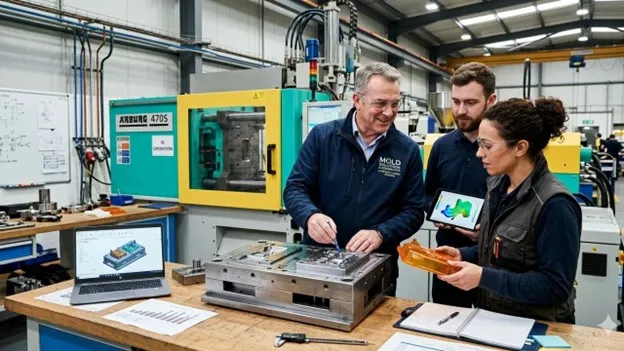
Most design issues do not show up on a screen. They show up later, when parts start coming out wrong, and no one is quite sure why. This guide walks through the kinds of mistakes that slip through early and how they get corrected before they turn into bigger problems.
What You Will Learn in This Guide:
You will see where part designs tend to fall apart once they hit production, what causes those issues in practical terms, and how small changes early on can save a surprising amount of time and cost later.
Where Things Usually Start to Go Sideways
A design can look perfect in CAD. Clean edges, nice symmetry, everything lined up just right. Then the first run happens, and something feels off. Parts stick a little, surfaces do not look as sharp, and dimensions drift just enough to raise concern. This is where the gap shows up between design and real-world molding. As an Injection mold consulting company, the focus stays on how that design will behave once heat, pressure, and material come into play. What works on a screen does not always translate cleanly into production, and that is where problems begin to creep in.
Wall Thickness That Quietly Causes Trouble
One of the most common things that gets overlooked is wall thickness. It rarely jumps out as a problem during design reviews, but it shows up fast during molding. Thick sections cool more slowly, which leads to sink marks or internal stress. Thin sections might not fill. There was a project where everything looked fine until a thicker corner kept pulling inward just enough to ruin the finish. Nothing dramatic, just enough to reject parts. Smoothing out that transition fixed it without touching anything else. Small detail, big difference.
Draft Angles That Get Left for Later
Draft tends to get pushed aside, especially when the focus is on how the part looks or fits. But once the mold is built, there is no ignoring it. Without a proper draft, parts resist ejection, surfaces drag, and cycle times stretch out longer than they should. It is one of those things that feels minor until it is not. Adding the right draft early makes everything easier later, from cleaner finishes to smoother production runs.
Features That Look Good but Complicate Everything
Undercuts, sharp corners, deep ribs, they all serve a purpose in design, but they come at a cost. More complex tooling, longer build times, and sometimes more points of failure during production. Not every feature needs to go, but every feature should earn its place. A small tweak can often remove the need for extra tooling components without changing how the part functions. That trade-off is worth paying attention to early.
Material Choices That Do Not Hold Up
Most of the time, the selection of materials is made in a hurry, depending on availability or initial specifications. After that, the process of shaping begins, and objects act in a manner that is not what was anticipated. Maybe the material flows too easily, maybe it holds heat longer than planned, maybe the finish is not what was expected. Inside a molding setup, those differences become obvious right away. The focus stays on how the material actually performs during the cycle, not just what the data sheet says. Sometimes the fix is as simple as choosing a better-suited resin.
Tolerances That Are Too Ambitious
Tight tolerances sound good on paper. They signal precision and quality. But in molding, they can create unnecessary pressure on the process. There have been cases where parts were designed with tolerances tighter than the application really needed, which led to constant adjustments and wasted material. Bringing those tolerances back to something realistic made production smoother almost immediately. Precision still matters, but it has to match what the process can reliably deliver.
How Design Reviews Are Handled
When designs come in for review, the focus stays practical and grounded in what actually happens on the floor:
- Thickness variations are checked to avoid uneven cooling
- Draft angles are reviewed to ensure clean part release
- Complex features are questioned to reduce tooling complications
- Material choices are evaluated based on real behavior during molding
- Tolerances are aligned with what can be produced consistently
Why Getting It Right Early Matters
Experience has shown that the majority of production problems at Convington Plastic Molding may be traced back to decisions made during the early stages of the design process. It is usually more difficult and expensive to fix problems later than it is to catch them early on. Even top injection molding companies rely on this kind of early review because it keeps projects from drifting off course. As an Injection mold consulting company, the goal is simple. Make sure the design works not just in theory, but where it actually counts.
Conclusion
If a design is heading toward production, it is worth slowing down for a second look. The small things that seem easy to ignore now tend to show up later when changes are harder to make. A careful review can catch those details early and keep the process running the way it should. Reach out to start the conversation and get the design aligned with real production from the beginning.
FAQs
Q1. What are the most common design mistakes in injection molding?
Common mistakes include uneven wall thickness, missing draft angles, complex features, wrong material choice, and overly tight tolerances that affect production.
Q2. Why is wall thickness important in part design?
It controls how the part cools and forms. Uneven thickness can lead to defects like warping, sink marks, or incomplete filling.
Q3. How do draft angles affect molding?
Draft angles allow parts to release easily from the mold. Without them, parts may stick, causing surface damage and longer cycle times.
Q4. When should material selection be reconsidered?
If parts show flow issues, poor finish, or deformation, it usually means the material is not suited for the design or process.
Q5. Why is early design review important?
It helps catch issues before production begins, reducing costly changes and ensuring smoother, more consistent manufacturing.